Targeted thermal eradication serves as an immediate intervention for active bedbug activity inside residential framing, eliminating the multi-week incubation delays associated with conventional aerosol surface sprays.…
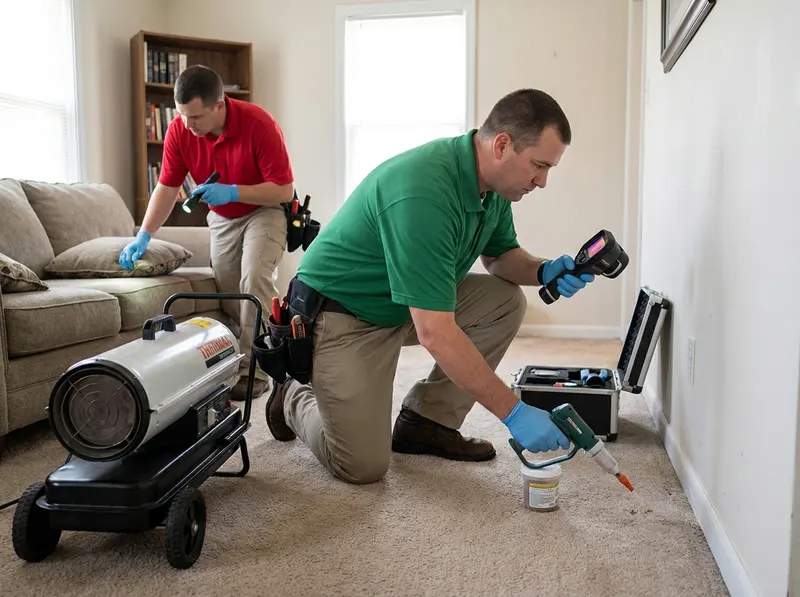
Targeted thermal eradication serves as an immediate intervention for active bedbug activity inside residential framing, eliminating the multi-week incubation delays associated with conventional aerosol surface sprays. A calibrated convective heating system raises structural core temperatures to a verified lethal threshold between 122°F and 135°F, which the U.S. Environmental Protection Agency identifies as necessary for denaturing internal insect proteins within minutes. Following the thermal soak, technicians apply localized micro-dusts containing amorphous silica to wall voids and structural transitions according to National Pest Management Association standards. This two-phase deployment prevents surviving instars from migrating into adjoining rooms, providing an immediate non-chemical knockdown alongside long-term mechanical barrier protection.
The mechanical application of heat fits heavily furnished residences throughout historic neighborhoods like Heritage Hills, Crown Heights, and Mesta Park, where dense lathe-and-plaster wall cavities allow insects to harbor deep beyond the reach of standard liquids. In modern slab constructions found in Quail Creek and Chisholm Creek, heat easily penetrates the base plate expansion joints where insects congregate. While standard liquid treatments require repeated applications spaced 14 days apart to target emerging eggs, heat eliminates both adult populations and embryonic stages simultaneously in a single eight-hour setup. The primary trade-off involves preparation rigor: homeowners must temporarily relocate heat-sensitive items, including vinyl window blinds, pressurized canisters, soft wax items, and sensitive electronics, prior to equipment deployment.
Treatment execution follows four distinct phases to ensure consistent lethal heat saturation. 1. Technicians place wireless thermocouple monitors inside deep structural voids and furniture cushions to verify uniform thermal penetration. 2. High-output industrial air movers distribute heated air across rooms, maintaining airflow standards aligned with the Centers for Disease Control and Prevention guidance. 3. Structural temperatures sustain a minimum of 122°F for at least 120 minutes across all perimeter edges, monitored continuously to prevent localized hot spots. 4. Once temperatures return to baseline ambient levels, crews place precision micro-baits and non-repellent residual barriers around electrical junction boxes and bed frame supports. This process satisfies municipal safety guidelines published by the City of Oklahoma City Code Enforcement.
Environmental variables in Oklahoma County demand adjustments based on seasonal humidity and building ventilation. Rapid atmospheric drying during summer heatwaves can drive insects toward cooler subterranean floor plates in multilevel homes in Nichols Hills and The Village. Furthermore, shared wall architecture across urban lofts in Deep Deuce and commercial-adjacent bungalows in the Plaza District require perimeter monitoring to ensure insects do not retreat through shared conduit runs. Technician equipment deployments align with worker thermal exposure limits established by the Occupational Safety and Health Administration, ensuring quiet, measured, and odor-free restoration of living environments without recurring sales agreements.
Every job gets a firm, written price after a free on-site visit.
For standards, safe disposal, and service guidance on PEST CONTROL SEVICE in Oklahoma City, OK, useful references include U.S. EPA, ENERGY STAR, U.S. Dept. of Energy, Consumer.gov, U.S. Census Bureau, and Google Maps. General consumer and small-business resources are available from USA.gov, Better Business Bureau, FTC Consumer Advice, U.S. Small Business Administration, and Ready.gov.
Tell us about your bedbug thermal and micro-bait application job in Oklahoma City and we'll send a clear, written quote, usually the same day.
 BugHaven Exterminators